
What community-sourced modelling actually asks for
On 14 August 2026, we spent a day in Ezhikkara Grama Panchayat with EQUINOCT, NPOC and the Lanka community.
This is a note about what we saw. It is also a note about why the model EQUINOCT is running here is different from what usually gets built in the coastal resilience space, and why we think it is worth backing even where the extra effort shows.
The three rooms
The morning began at the Panchayat committee meeting. Panchayat members were the audience. Dr. Madhusoodhanan from EQUINOCT explained the project in detail. The co-creation idea. The fact that this is a pilot, experimental by design. The fact that it sits on the back of EQUINOCT’s five-year prior engagement with this Panchayat. He was explicit that the project would be delivered on private land, for the twenty-three households of Lanka thuruth, and that what we needed from the Panchayat was institutional coordination with State departments and formal recognition of the beneficiary list. He referenced the Panchayati Raj Act. He stressed community consent as a condition, before any intervention.
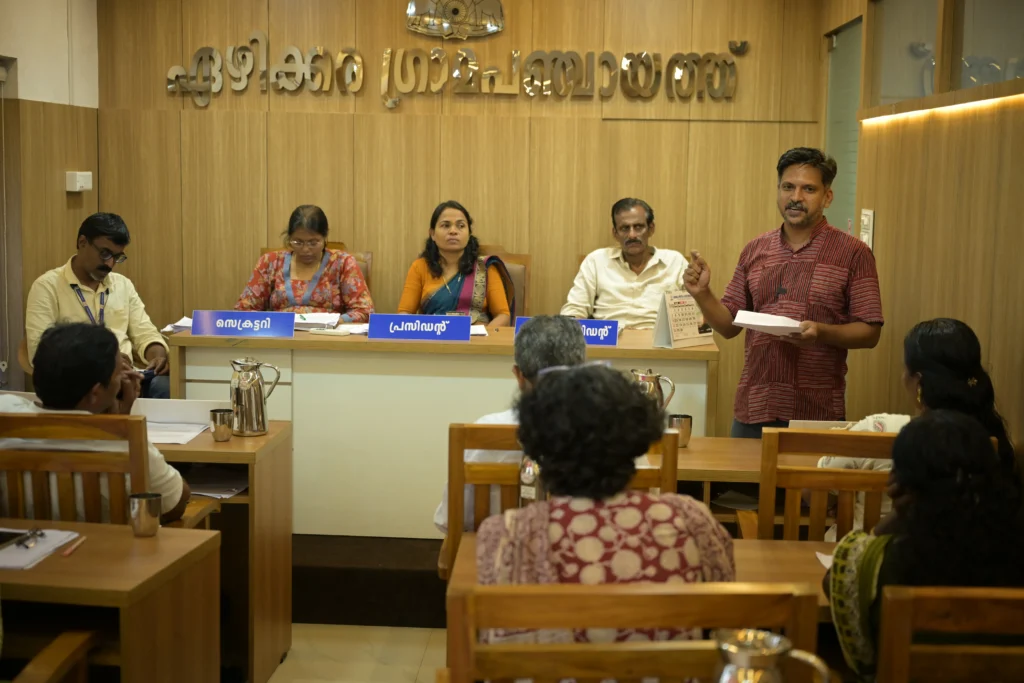
Two Panchayat members stood up and spoke. Both had thought about the flooding problem seriously. One of them is a former Panchayat president and a Pokkali farmer. That combination gave him a ground-level understanding that no external technical team can replicate quickly. The current Panchayat President stressed transparency, particularly around finances, given the substantial philanthropic capital involved and the State’s leadership taking an interest in this Panchayat. He also raised beneficiary privacy, particularly around digital data. He verbally committed to formally recognising the beneficiary list.
The room was aligned. Institutional acceptance was high.
The afternoon began on Lanka thuruth itself, with the beneficiary meeting. Shajan opened for EQUINOCT, explaining informed decision-making, the participatory approach, and the role of consensus. Dr. Madhusoodhanan spoke about EQUINOCT’s earlier work in the area, including the historical flooding calendar the team had left with households the year before, on which residents had marked water levels month by month.
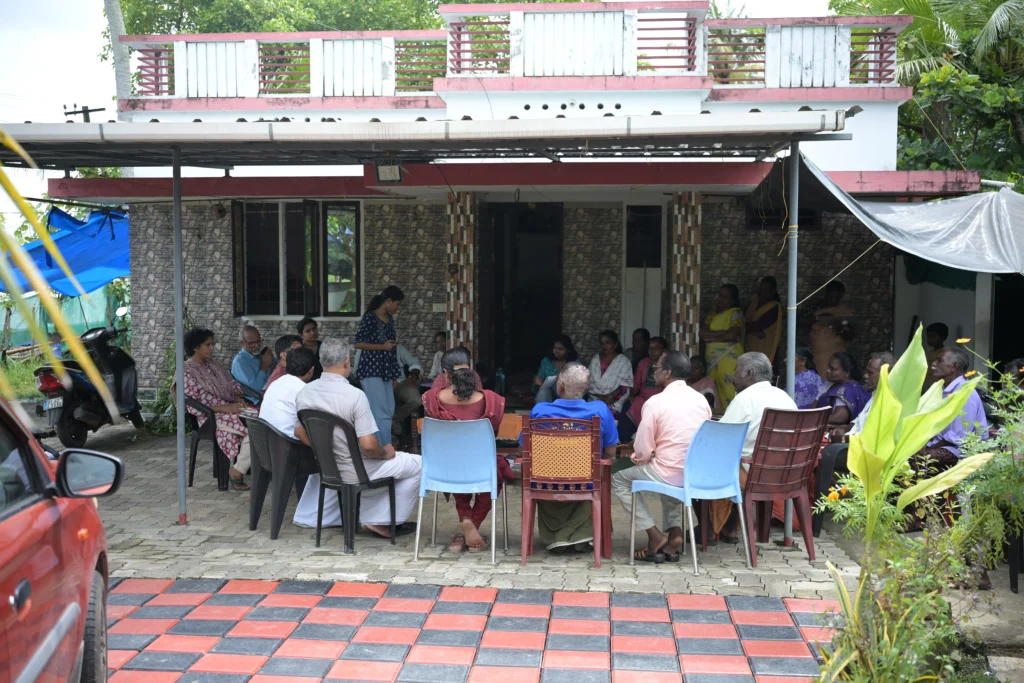
Then came the questions. Residents asked about brick walls. About where water goes when it enters homes. About how drainage actually functions once you build one. These were not naive questions. These were the questions of people who had been living with the problem for two decades. What became visible in that room was that the community holds significant practical knowledge, and comparatively limited scientific vocabulary. That gap is not a weakness. It is the exact thing a community-sourced modelling approach exists to bridge.
Two documents were introduced. A consent letter to be signed for the Gram Sabha resolution, and a separate privacy letter under the Digital Personal Data Protection Act framework covering how photographs, videos, household conversations and traditional knowledge would be handled. The beneficiaries were slightly guarded. This was the first formal engagement between the project and the community as a formal cohort.
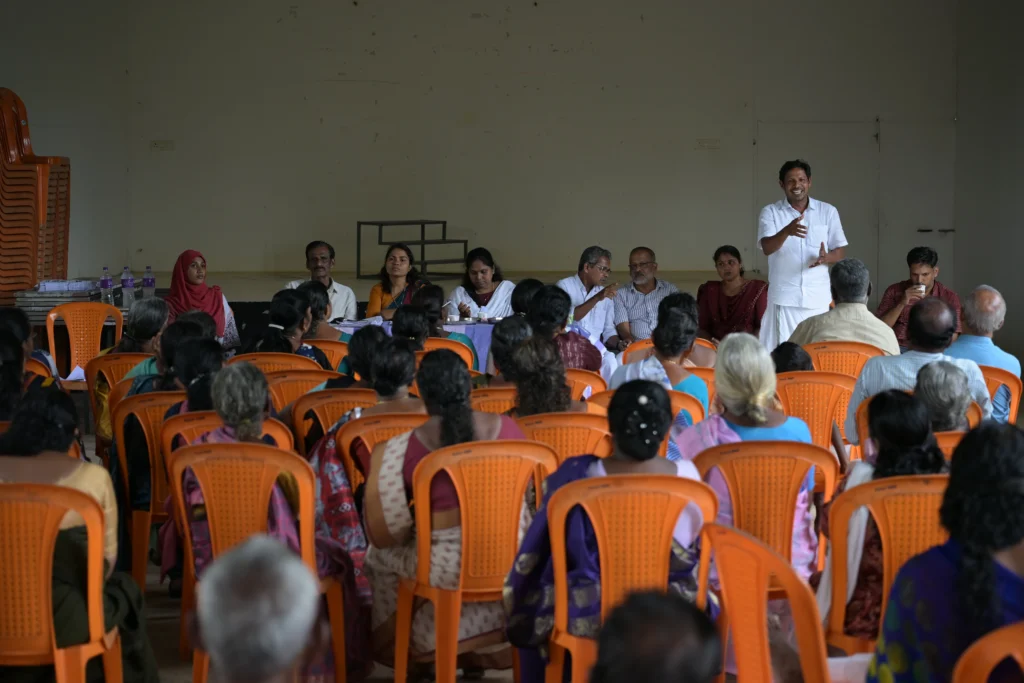
The evening ended at the Gram Sabha. The Panchayat President introduced the team. A beneficiary named Girish, who had taken careful notes during the earlier Lanka meeting, was asked to present the resolution. He struggled as the technical vocabulary was unfamiliar. A Panchayat member, Ratheesh, stepped in to explain the project, after which a second beneficiary supported the resolution. The Gram Sabha passed it with applause.
What community-sourced modelling actually asks for
Most coastal resilience work in India begins with an engineering firm arriving with a design, running a stakeholder meeting to tick the box marked “community consulted”, and then building. Sometimes it works. Often the infrastructure does not fit the community’s real needs, or does not survive the next tide, or is not maintained after the project closes. And without the communities on ground involvement the blame of failure shifts to the implementing agency.
The community-sourced modelling approach starts from a different assumption. It starts with the observation that a community which has lived with the problem for twenty years already holds a mental model of the problem, and that this model contains information the engineers do not have.
The intervention is designed to elicit that model, place it alongside the technical model, and build a solution that both can stand behind. This requires the community to actively contribute their understanding to the technical design, not just to be present at a meeting.
That is why the calendar-based flooding history matters. It is why the drainage question mattered. It is why the twenty-year narrative is being treated as data, not anecdote. It is why the M&E design being built by Nayaneethi is trying to measure not only whether beneficiaries participate, but whether their inputs actually change the design.
Why this is harder than it looks
The three rooms of 14 August show the specific ways in which this model is harder to run than a standard engineering project.
First, it requires multiple simultaneous approvals. Institutional (Panchayat), community (beneficiaries), and legal-political (Gram Sabha and above). Any one of these can slow the project. All three need to move roughly in step.
Second, it requires the community to gain technical vocabulary they do not currently have. Girish taking careful notes in the beneficiary meeting and then struggling to present the same content publicly is a real challenge. It is not a failure. It is the visible edge of a learning curve that has to be walked.
Third, it requires trust to be built slowly, over multiple visits, before it can be counted on. This is expensive in time and in patience. It is also the only way the work holds after Phase 2 closes.
Why we still think it is the right model
Because the alternative has a bad record. Any infrastructure that was designed without the local community involvement, and imposed on it, has a history of not lasting.
Because the community’s twenty-year memory of flooding is the closest thing to a dataset that anyone has for Lanka. Losing that to a top-down design would be a scientific loss, not just a social one.
Because the Panchayat is willing to sit at the table, and so are the residents. That is a rare alignment, and it deserves to be tested at pilot scale before being either scaled or dismissed.
And because if this model works in Lanka, it can be adapted for other coastal panchayats in Kerala facing similar conditions. That is worth the extra effort.

© 2026 Happiness Project. Kerala, India.